Cost of downtime: how to work out what an hour of IT downtime costs your business
Short answer: the cost of downtime for a small business is four numbers added together. They’re what you pay the people who can’t work, the income you genuinely lose, the cost of catching up, and any one-off bill the outage brings. For a ten-person UK office, an hour of IT downtime usually lands somewhere in the low hundreds of pounds. A full day runs into the thousands. The figure that matters is yours, and it takes about ten minutes to work out.
Most articles about downtime cost quote a big headline number. Usually it’s American, often it’s from a survey of large companies, and sometimes there’s no source at all. None of that tells you what an hour costs your business. This does, using figures you already have.
Already know an hour costs more than you’d like? See how backup and business continuity works, or ring 0151 452 3060.
Why the cost of downtime is worth working out
Because it turns a vague worry into a budget. If you know an hour of IT downtime costs your business £300, you can judge whether a second internet line, a tested backup or a better laptop setup is worth paying for. Without the number, every IT decision is either fear or guesswork.
It’s not a rare event, either. 43% of UK businesses identified a cyber breach or attack in the last year (DSIT 2025), and that’s before you count the dead server, the failed update and the broadband line cut by roadworks. Most businesses will have some downtime this year. The question is how long it lasts and what it costs.
How to calculate the cost of downtime per hour
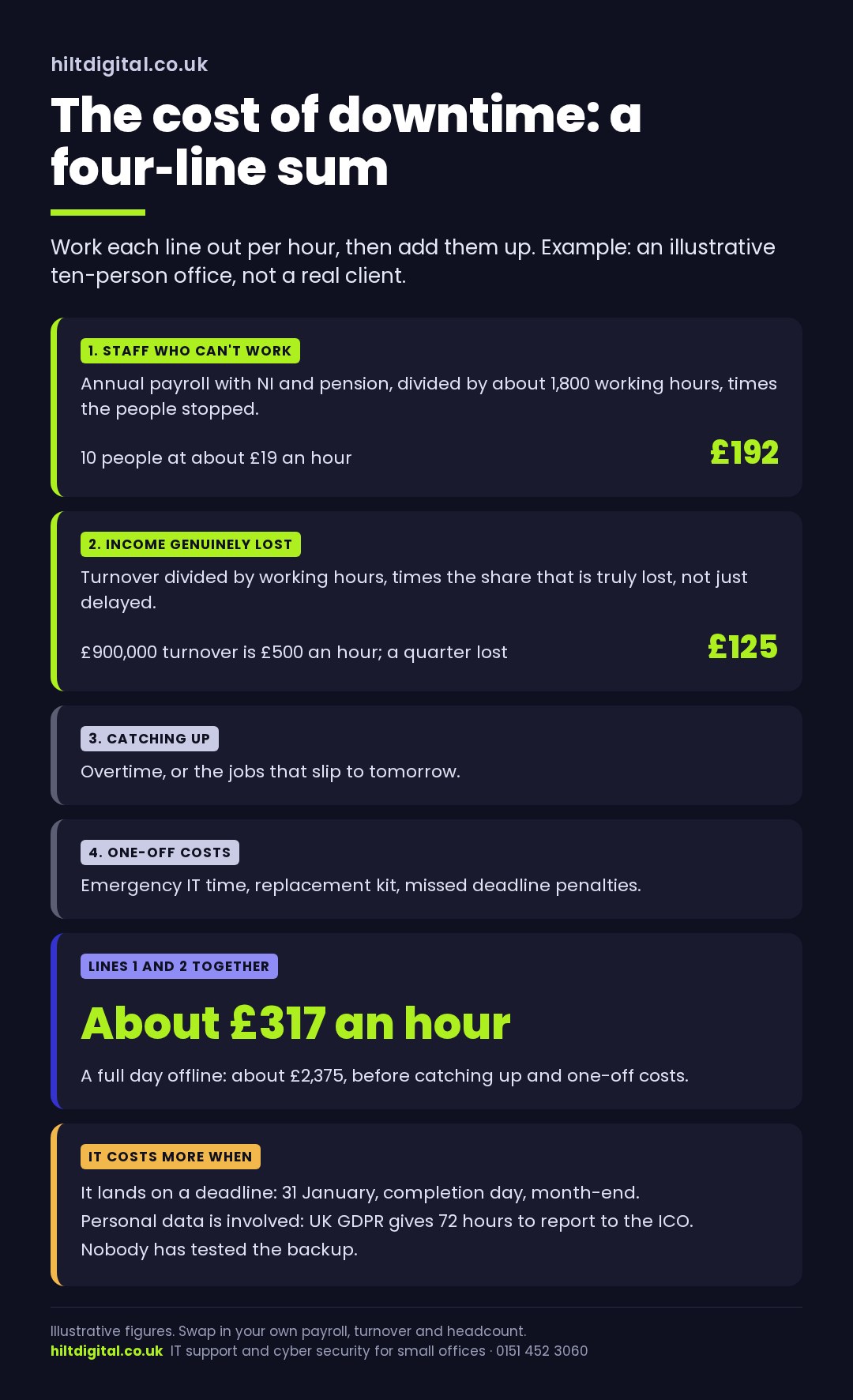
You need four lines. Work each one out as a cost per hour, then add them up.
1. Staff who can’t work. Take your annual payroll, including employer’s National Insurance and pension, and divide it by the hours your team actually works in a year. Around 1,800 is a fair figure for full-time staff once holidays come off. That gives you a cost per person per hour. Multiply it by the number of people an outage stops.
2. Income you genuinely lose. Divide your annual turnover by the same working hours. Then be honest about how much of that hour’s income is truly gone, rather than just delayed. An accountant whose systems are down for an hour mostly does the work later. A shop that can’t take card payments loses the sale. For most office businesses, a quarter of the hourly figure is a fair starting point. For anything customer-facing and time-sensitive, it’s much more.
3. Catching up. The work doesn’t vanish when the systems come back. It gets done in overtime, or it pushes tomorrow’s work back. Add whatever you pay for that, or the cost of the jobs that slip.
4. One-off costs. Whatever the outage itself brings with it: emergency IT time, replacement hardware, a missed deadline penalty, or the cost of telling clients something went wrong.
A worked example: the cost of IT downtime for a ten-person office
These are illustrative figures, not a real client. Swap in your own.
Say the office turns over £900,000 a year, and the ten staff cost £34,500 each once National Insurance and pension are added. They work about 1,800 hours a year.
- Staff: £34,500 divided by 1,800 is about £19 an hour, so ten people idle costs about £192 an hour.
- Income: £900,000 divided by 1,800 is £500 an hour. If a quarter of that is genuinely lost, that’s £125 an hour.
- Together: about £317 for each hour the office can’t work, before any catching up or one-off costs.
A full working day offline is about £2,375 on the same sums. Add a day of overtime to catch up and the cost of whoever fixes it, and a one-day outage is easily past £3,000. A ransomware incident that takes a week to recover from is a different scale altogether. The average cost of an impactful breach for a UK business is £8,260 (DSIT 2025), and that average includes businesses that recovered quickly.
Got your number? The next job is a plan for keeping it small. The business continuity planning guide walks through what a one-page plan needs, and backup and recovery for small businesses covers the part that decides how long you’re down.
The downtime costs that don’t fit a spreadsheet
The four-line sum is the floor, not the ceiling. Some of the biggest costs of business downtime only show up later.
Deadlines that don’t move. An outage on 30 January costs an accountancy practice far more than one in March, because HMRC’s online self assessment deadline is 31 January. The same goes for completion days for conveyancers and month-end for anyone running payroll. The cost of downtime isn’t flat. It depends on when it lands.
Reporting duties. If the downtime comes from a breach involving personal data, UK GDPR gives you 72 hours to report it to the ICO where it’s likely to put people at risk. That’s time and often outside help, on top of getting the systems back.
Clients. One outage is usually forgiven. A second one, or a slow and unclear recovery, is when clients start wondering whether their data is safe with you. That cost never appears on the invoice.
Five ways to cut the cost of downtime
Every one of these shortens the outage or stops it happening, which is where the money is.
- Test a restore. Pick one file from last month and get it back. A backup nobody has restored from is a hope, not a plan.
- Find the single points of failure. The one server, the one person with the admin password, the one internet line. Each one is an outage waiting for a date.
- Keep everything updated. Unpatched machines are one of the most common ways in for attackers, and updates are cheap.
- Switch on multi-factor sign-in. 85% of attacks start with phishing (DSIT 2025). Multi-factor stops a stolen password turning into a locked-out business.
- Write down who does what. Who rings whom, where the passwords live, and which systems come back first. Ten minutes of planning saves hours of confusion.
Cost of downtime: common questions
What’s the average cost of IT downtime for a UK small business?
There isn’t a reliable one. The widely quoted per-minute figures come from surveys of large, mostly American companies, and the UK ones in circulation rarely give a source. Your own four-line sum is more accurate than any average.
Should I use turnover or profit for lost income?
Turnover is simpler, and it’s fine for a rough figure. Gross profit is more accurate if your costs drop when work stops. Either way, only count the share of income that’s genuinely lost rather than just delayed.
Does downtime insurance cover it?
Some cyber and business interruption policies cover lost income after an incident, usually after an excess period. Check your policy wording for what triggers a claim and how long the wait is.
Know your number, then keep it small
Work out the cost of an hour. Then ask your IT provider one question: “If everything went down right now, how long would it take to get it back, and when was that last tested?” If the answer is a guess, the cost of downtime for your business is higher than it needs to be.
Ring 0151 452 3060 and you’ll get a straight answer on where your downtime risk sits. Small business IT support is £55 a person a month and includes tested backups of every device and Microsoft 365, updates and monitoring, so the hour stays an hour.