
Cyber security for accountants
Cyber security for accountants: protect client data, the practice and the payments
Cyber security for accountants and accountancy practices of two to thirty people, from a Microsoft partner run by someone who’s spent twenty years securing hospital and government systems. Client bank details, tax records and payroll sit in your systems, and your PI insurer, your AML supervisor and your clients all expect them protected. We run the cyber security services a practice actually needs, built into your IT support from £55 a person a month, with the price on this page.
Run to the NCSC’s Cyber Essentials standards. Microsoft and Datto partner. You deal with Eric, and the person who scopes it is the person who runs it.
Why accountants are a target for cyber criminals
An accountancy practice is worth more to a criminal than most businesses its size. You hold the bank details, National Insurance numbers and tax affairs of every client. You move money, or tell clients where to send it. And January and the weeks before every filing deadline are when everyone’s rushing, which is exactly when a fake HMRC email or a “new bank details” request gets clicked.
The attacks accountants actually get aren’t sophisticated. Invoice fraud and payment diversion from a hijacked mailbox. Phishing dressed up as HMRC, Companies House or a client. Ransomware that locks the practice management system three days before the deadline. Good cyber security for an accounting practice is the handful of controls that stop those, run every day and written down so you can prove it.

Cyber security services for accountancy practices: what’s covered
All of it is inside the IT support at £55 a person a month. One-off work, like a review or a client’s security questionnaire, is a fixed price.
Sign-in security
Multi-factor authentication on every Microsoft 365 account, every admin login and the accounting software where it supports it. The single setting that stops most mailbox takeovers, and so most payment diversion. If a password turns up in a breach, or an account starts behaving oddly, it’s locked out automatically.
Email filtering
Fake HMRC emails, supplier impersonation and malicious attachments stopped before anyone reads them. With 85% of attacks starting in an inbox (DSIT 2025), this is where most of the stopping happens for an accountant. Phishing practice helps staff spot the ones that get through.
Threat detection and response
Every machine watched for the behaviour of ransomware and credential theft. A compromised laptop is isolated automatically before it can reach client files, and every laptop is encrypted, so a lost one isn’t a data breach.
Patching on a schedule
Windows, Office and the practice software kept up to date, with critical fixes inside the 14 days Cyber Essentials asks for, timed around your deadlines rather than in the middle of them.
Backups that restore
Client files, email and Microsoft 365 backed up daily somewhere ransomware can’t reach, and restored on a schedule to prove it works. Cloud ledgers like Xero hold their own data; what’s on your machines and in your mailboxes is yours to protect.
Evidence for the questionnaire
Controls written down against Cyber Essentials and kept current, so when a PI insurer, AML supervisor or larger client asks, the answer is a document rather than a scramble.
Cyber security and your obligations as an accountant
Nobody hands an accountancy practice a single cyber security rulebook, but several things you already answer to assume you’ve got it covered.
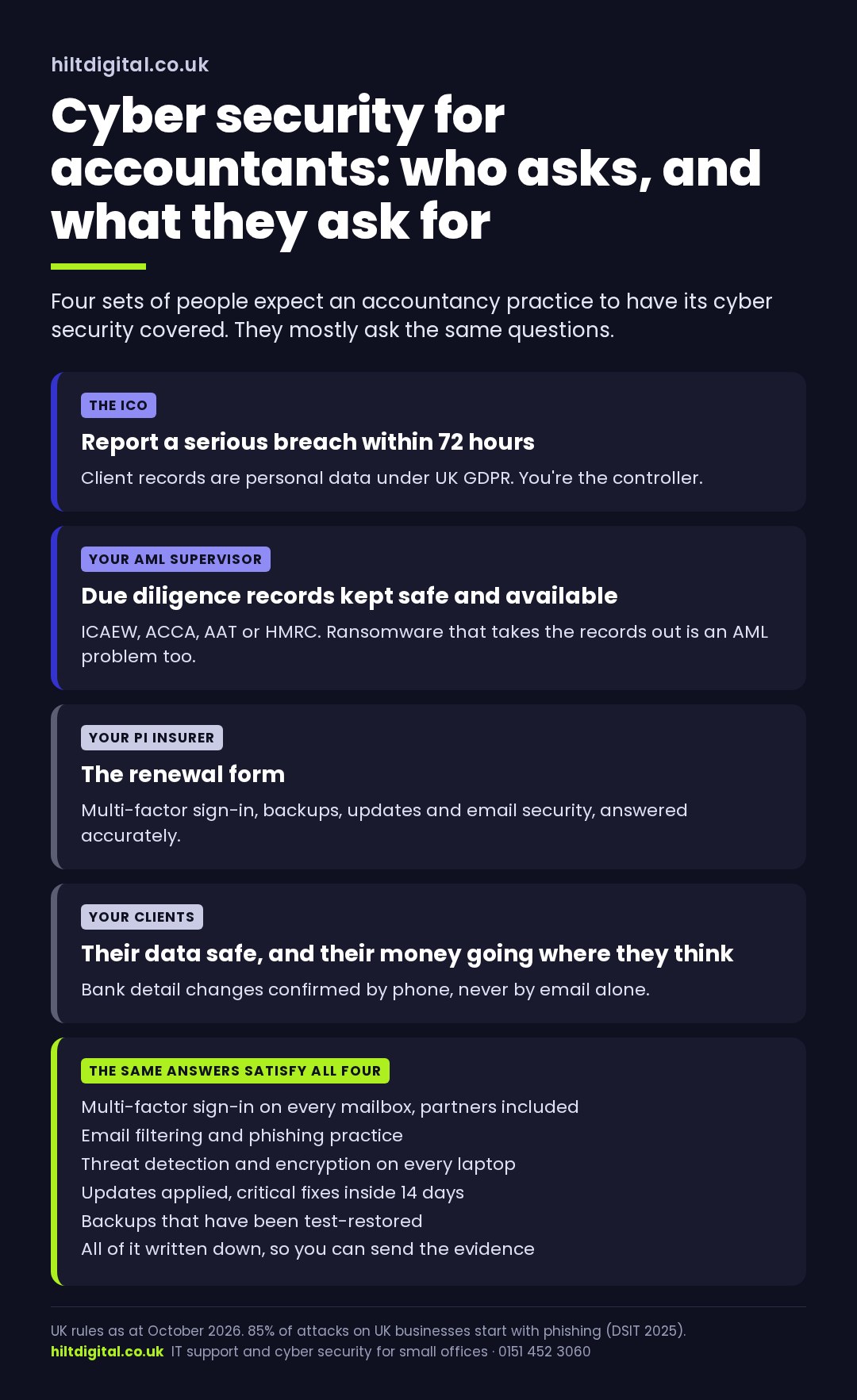
UK GDPR and the ICO. You’re a controller for client personal data. A breach that’s likely to affect clients has to be reported to the ICO within 72 hours, and “we didn’t have multi-factor sign-in” is a hard thing to put in that report.
Your AML supervisor. Whether that’s ICAEW, ACCA, AAT or HMRC, they expect client due diligence records to be kept securely and available. Ransomware that takes those records out is an AML problem as well as an IT one.
Your PI insurer. Renewal forms now ask about MFA, backups, patching and email security in detail. Cyber security for accountants is increasingly what decides the premium, or whether there’s cover at all.
Making Tax Digital. More of the work’s now online and authorised through software, so the accounts that sign into HMRC services need the same protection as the bank.
Cybersecurity for accounting firms: six questions to ask yourself
Whether you call it cyber security or cybersecurity, these six tell you most of what you need to know about where an accountancy practice stands. If you can’t answer three of them, that’s what the first month of our cyber security for accountants fixes.
- Is multi-factor sign-in on for every mailbox, including the partners’?
- Would anyone notice if a rule started forwarding a partner’s email outside the practice?
- When did someone last restore a client file from the backup, and does it include email?
- Is every laptop patched and protected, including the ones used at home during deadline season?
- Did the last person to leave lose access to email and the practice software the same day?
- If your PI insurer asked for evidence of all that tomorrow, could you send it?
A cyber security partner for accountants who already have IT support
Plenty of accountancy practices are happy with the IT company that keeps the printers and laptops going. What’s missing is somebody who owns the security. The PI renewal form has questions nobody can answer, a corporate client wants a supplier security questionnaire back by Friday, or the partners want to know whether Cyber Essentials is realistic.
That’s a fixed piece of cyber security work. Eric reviews what’s in place, tells you plainly where the gaps are, and writes up the evidence. Or it’s co-managed cyber security: your IT company keeps the helpdesk, we run the security alongside them, and the boundary’s written down so both sides know whose job an alert is. That’s priced per person and agreed before we start.

What cyber security costs an accountancy practice
Cyber security for an accountancy practice is inside our managed IT support at £55 a person a month, covering every machine that person uses. That’s threat detection and response, device encryption and management, email filtering, phishing practice, multi-factor sign-in, updates and tested backups. It also covers breached-password monitoring and account-takeover alerts that lock a compromised account out automatically. For example, a practice with two partners and four staff is £330 a month. Microsoft licences are bought direct from Microsoft and billed separately; we manage them. A server or other kit can change the number, so for an accurate quote, book a quick discovery call. A review or a questionnaire is fixed price.
After your first year it’s rolling 30-day notice with no exit fees, and you know the whole number before you agree to anything.
Cyber security for accountants, priced
Same number every month. Microsoft licences billed separately.
Secured in 7 Days, or that month is on us.
Cyber security for accountants: the questions practices ask first
What cyber security does an accountancy practice actually need?
Multi-factor sign-in on every account, email filtering, threat detection on every machine, patching on a schedule, backups that are tested by restoring, and the evidence written down. That covers the attacks accountants actually get: payment diversion, fake HMRC emails and ransomware.
How much do cyber security services for accountants cost?
It's inside our managed IT support at £55 a person a month. That covers threat detection, encryption, email filtering, phishing practice, breached-password monitoring with automatic lock-out, and tested backups. Microsoft licences are billed separately. You'd know the whole number before agreeing to anything.
Will this help with our PI insurance renewal?
Yes. The controls are the ones insurers ask about, and we keep a written record of what's in place, so the renewal form becomes a document you send rather than a guess.
Do you work with Xero, Sage and practice management software?
Yes. We secure the machines and the Microsoft 365 accounts the software is used from, set up multi-factor sign-in where the software supports it, and time updates around your deadlines.
We already have an IT company. Can you just do the cyber security?
Yes, that's co-managed cyber security. They keep the day-to-day support, we run the security alongside them, and who does what is written down. It's priced per person and agreed before we start.
Where are you, and do you cover our area?
Eric's on the Wirral and covers accountancy practices across the UK. Almost all of the work is done remotely, and anything that needs a visit is booked in.
Have a chat with Eric
Fifteen minutes with Eric. Bring the PI insurer’s form if that’s what started this.
Cyber security for your accountancy practice, done properly
Cyber security services for accountants, built into IT support at £55 a person a month, with nothing bolted on later. Ring and a person picks up.
Not ready to talk yet? Request a free health check.